
What Nelson County Property Tax Records Show
Tax facts in Nelson County sit in different offices. The Commissioner's Land Book and appraisal papers describe taxable ownership and assessed values. The Treasurer's side covers amounts charged and whether payment was made. Appeal material tells its own story. The 2026 Board of Equalization packet forms name the fields used when a property owner challenges a value.
| Field | What It Shows | Where |
|---|---|---|
| Owner and map number | Taxable owner and parcel key | Commissioner / Land Book |
| Land and improvements | Separate assessed components and total | Assessment card / Form 907 |
| Use value and classification | Assessment fields tied to land-use treatment | Commissioner |
| Bill number and amount due | Payment identifier and tax charge | Treasurer |
| Payment or delinquency | Collection status and court-sale notices | Treasurer / Circuit Court |
Virginia law sets real-estate assessments at fair-market value, subject to statutory land-use treatment. The local rate then applies to taxable assessed value. A bill therefore reports the tax charge, never what a buyer actually paid. For consideration or transaction terms, check the deed. For a balance or payment status, ask the Treasurer.
Nelson County Commissioner and Land Book
The Commissioner of the Revenue prepares Nelson County's Land Book. The office also keeps the taxable owner records current. It runs the land-use program and real-estate relief for elderly or disabled residents. County forms include a disabled-veteran real-estate exemption form. The form set is the right place to confirm current requirements. Eligibility rules vary by program and parcel.
Keep assessed value, taxable value, and relief status separate when you read the roll. A land-use classification can change the taxable figure. A relief form may change the tax obligation under a different program. Before filing anything, use the Commissioner's current application. Ask which supporting papers the office needs.
The Commissioner's forms page lists real-estate forms and notes payment requirements. It also warns that online payment can carry a convenience fee.
The county forms page is the local source for land-use and exemption paperwork.
Looking Up a Nelson County Tax Bill
The Treasurer handles billing and collection. The county-linked online payment form asks for a bill number, tax map number, and credit card. A convenience fee based on the amount applies. A street address can help identify the account. Even so, the county names the bill and map numbers as the payment inputs. Pull those from the bill or parcel record before you use the payment site.
- Find the parcel and copy its tax map number from CivQuest or the assessment record.
- Locate the bill number on the Treasurer's bill or contact the office if it is missing.
- Use the county payment destination or the linked Official Payments route and review the convenience fee.
- Call the Treasurer for a balance or delinquency question that the online route does not resolve.
- Assessed value
- The value used by the county to set the tax charge, subject to any applicable land-use assessment.
- Tax rate
- The rate applied to taxable assessed value; the current year rate should be checked with the county.
- Land-use value
- A statutory assessment treatment for qualifying land; ask the Commissioner about the local program and forms.
- Tax lien
- A claim tied to unpaid real-estate tax, with later steps governed by law and court process.
Nelson County Real-Estate Tax Calendar
The county's posted schedule lists two real-estate bills each year. Treat that as a guide to the local cycle. Check the county's current tax page for any later change.
| Bill cycle | Mailed | Due |
|---|---|---|
| First half | May 1 | June 5 |
| Second half | October 1 | December 5 |
The published rate has been $0.56 per $100 of assessed value. A dated rate is not a promise about a later fiscal year. The Nelson County tax-rate and date page is where you verify a current charge.
The posted county table ties the two due dates to real-estate bills.
The published rate is 56 cents per $100 of assessed value. It illustrates how the math works. Applied to a $250,000 taxable value, it gives a base of $1,400. That figure comes before any relief, land-use treatment, account adjustments, or later rate change. It explains the rate, not a parcel's actual bill. For the amount due, use the Treasurer's current bill and account balance.
Nelson County Treasurer Payment Route
The Treasurer is the right office for payment receipt, balance, and collection questions. You will find the office at 84 Court House Square, P.O. Box 100, Lovingston, with weekday hours from 8:00 a.m. to 5:00 p.m. Mailed checks for real estate and related taxes should be made payable to "NELSON COUNTY TREASURER." The phone is 434-263-7060.
Paying online is separate from checking an assessed value. Keep the bill and map number at hand. Read the fee before submitting card details. Reach the payment service through the official county page. If a mailed bill never arrives, ask the Treasurer to confirm the account. Do not treat a parcel map as a balance statement.
After payment, keep the confirmation number, date, amount, and parcel identifiers with the bill. A card receipt proves a submission was made. The Treasurer's account record settles whether it posted to the correct tax period. Payment may have covered a prior owner. The parcel may also have changed hands. Ask the Treasurer to verify the account before drawing any conclusion about title or delinquency.
The Treasurer page lists office contact and payment links.
The Treasurer contact page is the county source for bill and payment questions. For the online route, use the county-linked payment portal.
When entering a payment, use the bill number and tax map number from the county record.
Nelson County 2026 Reassessment Cycle
Nelson County's general reassessment took effect on January 1, 2026, and Wampler-Eanes Appraisal Group performed the work. The county runs its reassessment on a four-year cycle. Fieldwork was expected to wrap up in October 2025, with notices following the next month; the county FAQ says those notices went out in late November. That timeline sets up the 2026 value roll. Ownership or mailing changes that came later can be processed separately.
Virginia's four-year rule for county reassessments sits in Va. Code § 58.1-3252. The county's 2026 reassessment page names the contractor and the effective date.
Nelson County posted a follow-up on its 2026 reassessment. The county's reassessment update page links to the notice and appeal information for that cycle.
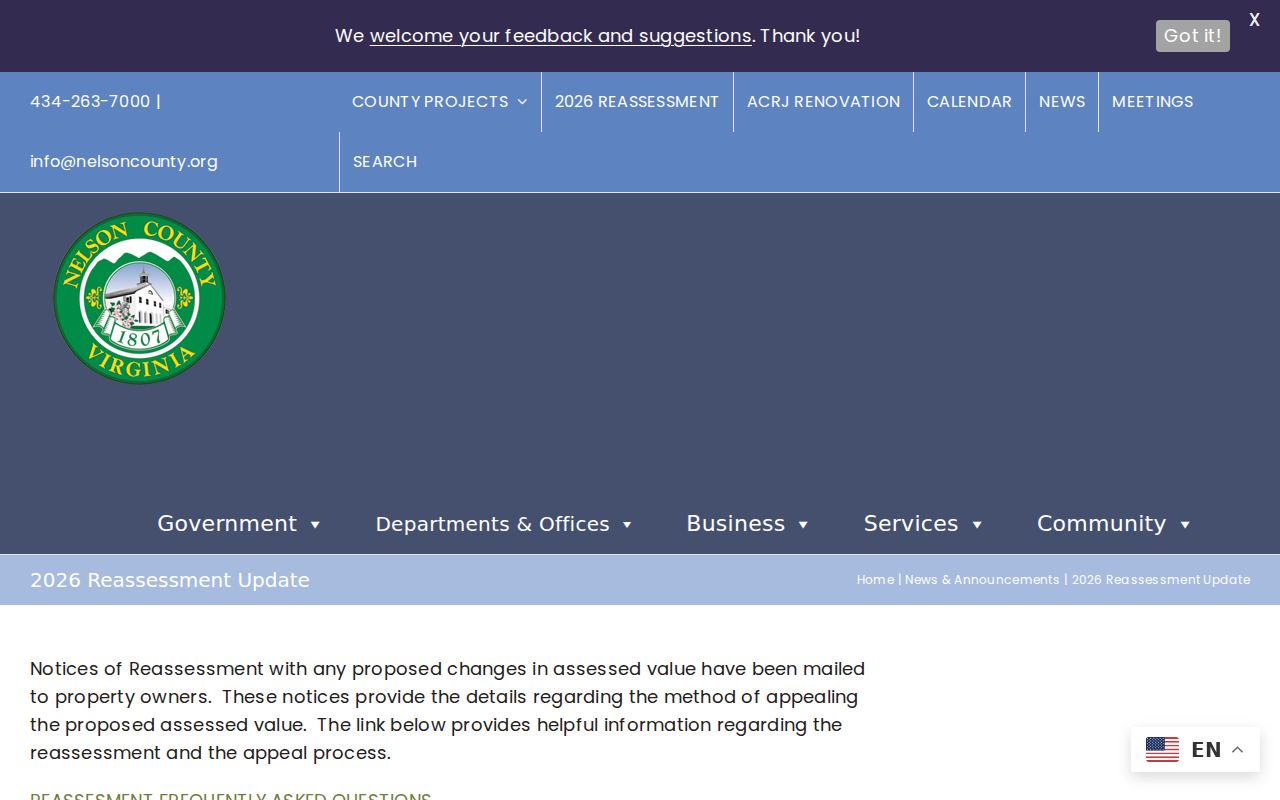
The update notice supplies cycle-specific dates that should be checked against current county instructions.
Nelson County Delinquent Tax Records
A past-due tax bill and a judicial sale notice are not the same thing. The Treasurer collects real-estate taxes in Nelson County. Tax-auction information from the county describes its delinquency process. A judicial sale notice rests on a Circuit Court order. Each notice names the parcel by last owner of record, tax map number, court file number, and a brief property description. Don't assume a sale is scheduled. For any parcel named in a notice, match the map number in CivQuest first, then pull the court file and land records for the order, sale confirmation, and any recorded deed transfer. Virginia Code § 58.1-3965 et seq. governs it. The county offers no single searchable delinquency list. The Treasurer's tax-auction page explains how the process works.
Nelson County answers delinquent real-estate taxes through its auction process. A current court notice can be checked on the county's judicial sale notice page.
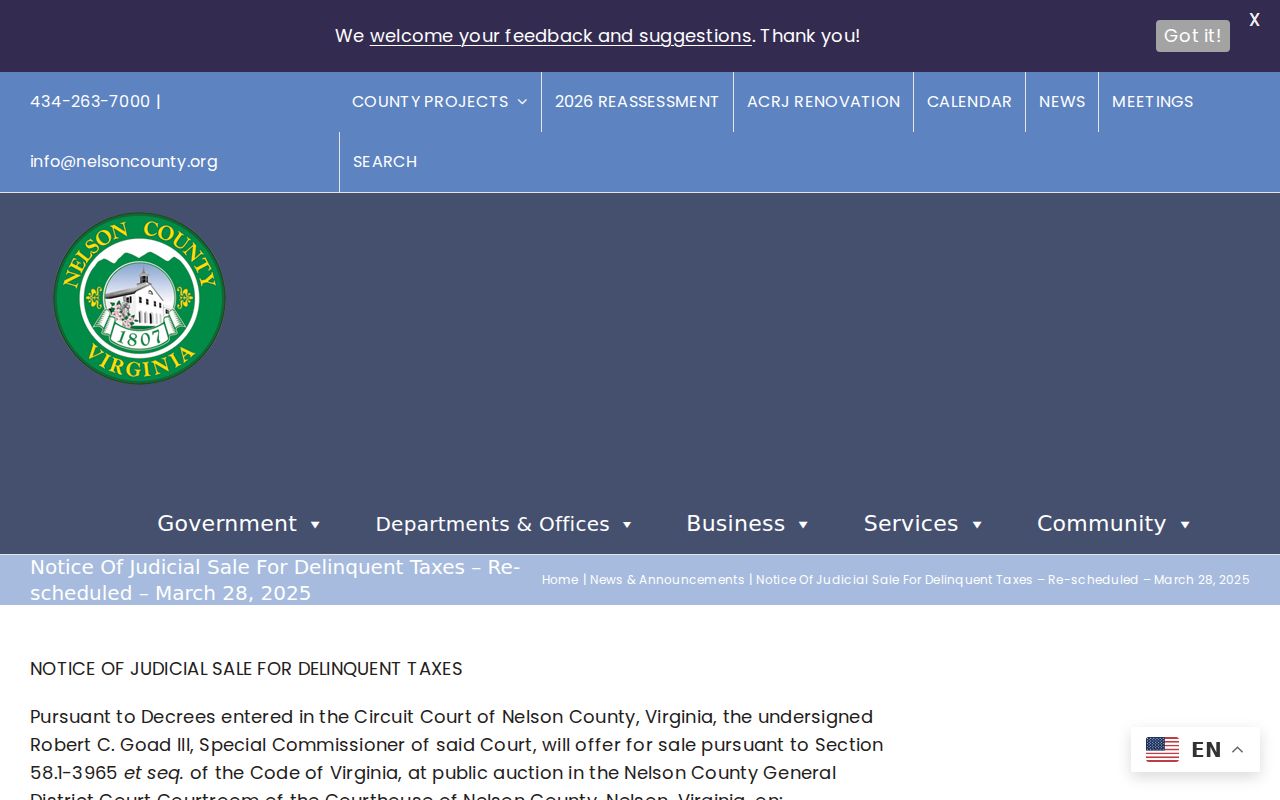
The notice links owner, map, court file, and description.
Appealing a Nelson County Assessment
The 2026 appeal path had three steps. Notices went out, then informal hearings opened, running December 8 through 19, 2025. A Board of Equalization review came next, and a Circuit Court appeal sat at the end of the road. The BOE set March 2026 hearing dates. Its filing deadline was April 15, 2026. Those dates have passed. Any later window, form, or hearing schedule comes from the current county notice, since each cycle stands on its own.
The Board's notice cites Va. Code §§ 58.1-3378 and 58.1-3379. The taxpayer carries the burden. You must show a preponderance of evidence that the assessment exceeds fair market value or lacks uniformity with similar property. The packet includes Form 907, the Real Property Questionnaire. Its fields cover owner, map number, address, acreage, land value, improvements, fair-market value, use value, and reasons for the appeal. For residential property under four units, Va. Code § 58.1-3331 covers notice and access to working papers.
Evidence works by comparison. Line the parcel up against similar properties and explain how the land or improvement fields differ. A taxpayer may inspect appraisal cards and working papers. That includes methodology, comparable sales, surveys, formulas, or a written reason for an increase, subject to confidentiality rules. The Board can affirm, lower, or raise an assessment. The Board of Equalization notice carries the evidence rules and dates for its cycle.
The notice offers a dated snapshot of how the 2026 Board appeal process was structured, though steps may change in later cycles.
Check the notice. The 2026 Nelson County deadline has passed. Obtain the current filing dates and evidence form from the county before preparing a new appeal.