
Nelson County Deed Records and Instruments
Every property transaction in Nelson County passes through the Clerk's recording process. Each instrument answers a different question. A deed moves an interest in land to a new owner. A deed of trust secures a debt against that land instead. When the debt is settled, a release or satisfaction documents the discharge. Plats define lots and subdivisions. Estate documents include a deed of distribution and an executor's deed. They transfer land through probate. These papers are related. Still, each one proves something distinct.
| Deed Type | What It Does | Common Use |
|---|---|---|
| Deed | Records a conveyance or other transfer of an interest | Check parties, date, and legal description |
| Deed of trust | Records a secured obligation tied to land | Match it with a later release or satisfaction |
| Release or satisfaction | Records discharge of an earlier instrument | Use its reference to find the original filing |
| Plat | Shows a mapped lot or subdivision layout | Compare with deed description and survey |
| Estate or court transfer | May convey property after probate or judicial action | Check the related order and recorded transfer |
Deeds and deeds of trust are the most common instruments the Nelson Clerk records. The live SRA instrument-type list is not publicly exposed. Read the document before assuming any particular deed label or guarantee type. A recorded deed of trust, lien, or loan is not proof the debt still stands. Look for a release, satisfaction, later foreclosure filing, or court order before concluding anything. Match each release to its original deed of trust. Check the borrower, lender or trustee, property description, and filing reference. Never infer that an encumbrance ended from a tax payment. Never infer it from a note about the debt.
Other instruments shape how a transfer reads. A lis pendens signals a pending property case. An easement or right-of-way can limit use without changing the owner of record. Covenants, partition orders, and boundary-line agreements explain rights and parcel shape. Each one deserves a look during a deed search.
Nelson County SRA Index and Images
Virginia's SRA/COVERS layer opens the door to Circuit Court Clerk land records. Those records are kept under state law. Index-only access is free when an individual Clerk enables it. Images work differently. Viewing a document image requires a subscription the Clerk authorizes. An agreement and fees apply as well. Nelson's oldest online index year is not stated in the public materials. The full document-type control list is not published.
Treat an SRA search result as a pointer, not the official court record. The system itself says its information is not official. Use the book, instrument, and party details to ask the Clerk for the authoritative filing. Older deeds missing from the online index call for a search of the courthouse books or microfilm. Guessing at a cutoff year is not a real answer.
Online access is not the only channel. Nelson County provides full land-record search in its public-records room. A missing image may mean a subscription is required. An older book may sit outside the index, or the search terms may need adjusting. Confirm Nelson's coverage years and image fees with the Clerk directly. Another county's setup will not answer for this one. The Virginia SRA/COVERS information spells out the public-index and subscriber-image split.
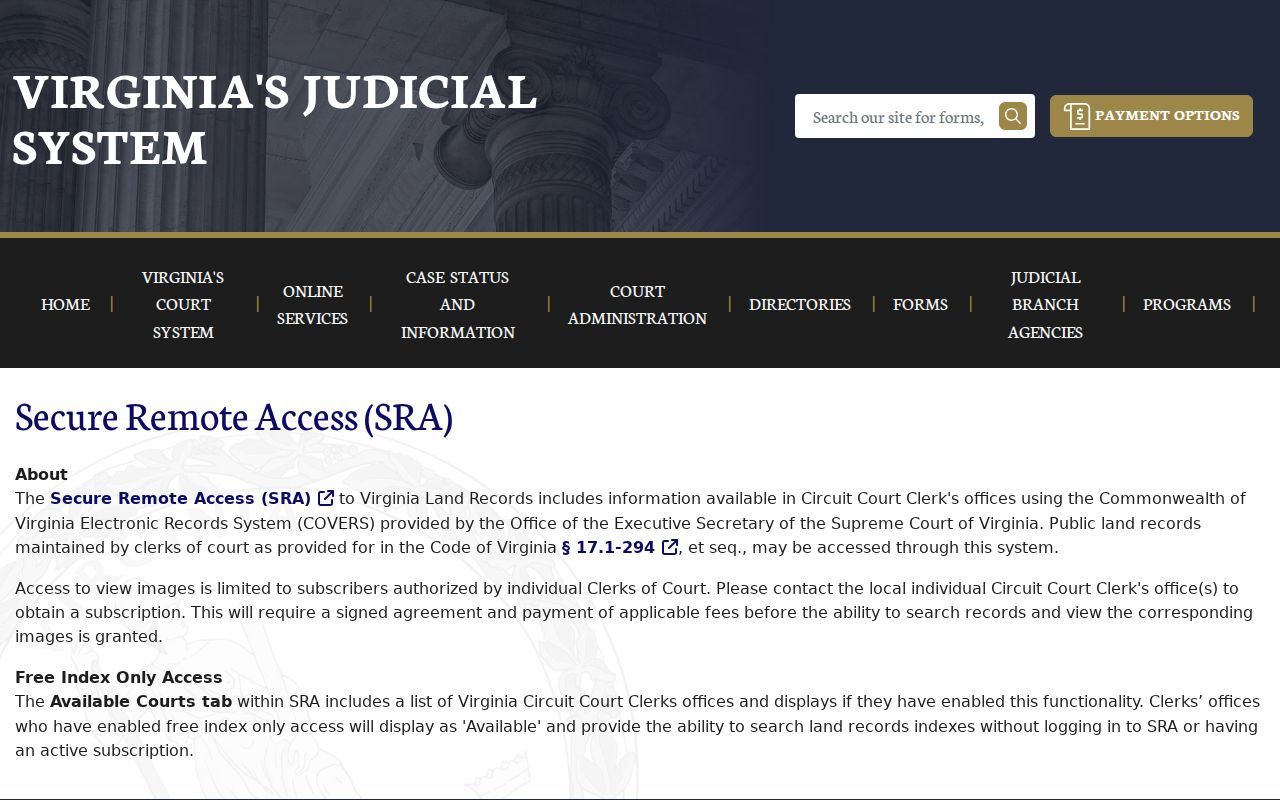
The access explanation helps separate finding an index entry from opening its image.
Nelson County Deed Receipt Fields
A county planning packet carries a sample deed receipt from the Nelson Circuit Court. Its fields show how a filing can be tracked across both the receipt and the land record. Treat these as receipt fields, not confirmed SRA search controls.
| Filing trail | Time, case number, transaction number, filing type, register number, recorded date and time |
|---|---|
| Parcel and parties | Location, party/name, PIN or map number, including a 22-A-5B example |
| Document details | Pages, names count, plat-in-case text, assessed value |
| Payment record | Payment status, exemption flag, fee descriptions, account codes, amount paid |
The Nelson County courts page describes Clerk custody and the land-records room.
The county's land-record page names deeds and deeds of trust as Clerk-held property records.
For a follow-up search, copy the receipt's case, transaction, and register numbers exactly. Keep the tax map number in its own field. The sample lists a filing type plus a recorded date and time. That helps when two instruments involve the same parties. A plat-in-case entry can point to a drawing tied to the filing. Yet the receipt never replaces the recorded deed or plat itself. The online index sometimes shows only a partial description. Ask the Clerk to identify a document by its filing reference in that case.
Comparing two receipts means weighing party, property location, and filing date together. A shared name alone can lead to a different parcel or a later release. Page counts and payment or exemption notations are receipt details only. They do not prove who owns the land or whether a loan is still open.
The Nelson County Grantor-Grantee Index
The grantor conveys the interest, and the grantee receives it. In a Nelson County deed search, use the name and instrument reference from a known transfer. That reference helps you locate the next record. Keep the parcel description beside the names at every step. One owner can hold several tracts. The same name can even belong to unrelated parties.
- Find the instrument for the parcel using a known grantee, map reference, date, or receipt number.
- Read the grantor, grantee, legal description, and recording reference from the document.
- Look for a later release or related order if the instrument secures a debt or reflects a court matter.
- Ask the Clerk about older books when the online coverage is unclear; the Nelson cutoff was not verified.
- Grantor
- The party conveying an interest in the land.
- Grantee
- The party who receives an interest in the land.
- Chain of title
- The sequence of recorded transfers used to trace ownership.
- Book/page or instrument number
- A locator printed on the record or receipt; copy it exactly when asking the Clerk for a filing.
Nelson County Clerk's Public Records Room
Nelson County keeps its land records in the Clerk's public-records room. The room sits on the first floor at 84 Courthouse Square in Lovingston. The county describes that room as the place where land records are fully searchable. Office hours run 8:00 a.m. to 4:30 p.m. But the cash registers close at 4:15 p.m. Recording windows are tighter still. Land-record recordings are accepted only from 8:00 a.m. to 4:00 p.m. Those three cutoffs differ, so time a recording or payment visit around the shortest one. Fees can be paid in cash, by check, or by money order. The county publishes no full fee schedule for copies or recordings. A request may need a fee or a specific search. Call the Clerk at 434-263-7020 before traveling in that case. Mail goes to P.O. Box 10, 84 Courthouse Square, first floor, Lovingston, VA 22949-0010.
Nelson County Deed Books Before Online Search
Nelson County dates to 1807, when it was formed from Amherst County. That origin shapes any deed search reaching back before the county itself. Older conveyances may sit in the predecessor county's records. The Clerk's public room is the local starting point. But it is not always the last stop. The Library of Virginia holds Nelson County microfilm. Its catalog entry lists the reels by book and year span. That helps you pinpoint the film you need before a visit. Ask the Clerk or the Library of Virginia which reel covers your period. For a historic tract, carry the deed's stream, road, acreage, adjoining-owner, and parent-tract calls. Bring the map number too. Nelson Memorial Library's Historical Society files can add family and community color. They do not replace a recorded conveyance. The Library of Virginia's Nelson County microfilm catalog is the repository index.
Getting a Nelson County Deed Copy
Start with SRA/COVERS. Check whether it offers deed-image access under the Clerk's current rules. If not, contact or visit the Circuit Court Clerk directly. Supply the parties and the recording date or reference. Include enough of the legal description to identify the filing. The public-records room remains the confirmed route for a full deed records search. Fees there are payable by cash, check, or money order. The county posts no current copy-fee table. Ask the Clerk about any copy format or certification requirement before you visit. Older land records work differently. Ask about the deed books and the matching index first. Then order the copy. A Virginia FOIA request is another route to a specific public record. It works when the record is not otherwise available. It does not substitute for a normal Clerk search or a certified copy. A request routes faster with the right details. Give the grantor and grantee. Add an approximate recording date and the instrument or book-and-page reference. Include the tax map number if known. A legal-description clue helps too. Use acreage, road or stream calls, or an adjoining owner that ties the filing to the parcel. The county also links a Virginia Deed Alert System information sheet. That tool sends notices of new filings. It is not title insurance. It is also not proof that a filing is fraudulent. Register only through the Clerk or a county-confirmed route. An alert may name a document. Verify its instrument number and recording date with the Clerk. The county Deed Alert information sheet explains the state system.
Recorded, not guaranteed. A Nelson County deed entry documents a filing, not a complete title opinion. Confirm the full chain and related releases with the Clerk or a title professional.