
Tracing Former Owners of a Nelson County Property
Nelson County holds several routes into past ownership. Their date ranges differ, though, and the county publishes no online index cutoff. The local records room is fully searchable. The Library of Virginia also lists county microfilm. Treat the source table as an access map, then ask the Clerk or a repository about the exact year span you need.
| Source | Years It Covers | Where Held | What It Shows |
|---|---|---|---|
| SRA/COVERS index | Online cutoff not stated | Virginia land-record access | Party and instrument leads where enabled |
| Clerk deed books | Ask Clerk for the volume range | 84 Courthouse Square, Lovingston | Full local land-record search |
| LVA microfilm | Use catalog rows to identify reels | Library of Virginia | Historic county records on film |
| Plats and probate | Record-specific | Clerk and Circuit Court files | Parcel splits and estate transfers |
Begin with the latest deed. Work from there. When a chain reaches past the online index, ask the Clerk about deed books and use the LVA county catalog to locate relevant microfilm. For a parcel carved from a parent tract, pair the deed with the recorded plat. Tax rolls and family-history files add context. But they never replace a recorded conveyance.
Nelson County Online Index Depth
The SRA/COVERS landing page explains the state route. But its official text names no earliest online year for Nelson County deed records. Do not borrow a cutoff from another locality. Never infer one from a search result, either. Ask the Clerk how far back a name or instrument searches online, and which older deed books or indexes cover the gap.
Index access and image access are separate. Free index-only access exists where a Clerk has enabled it. Document images may require a subscriber account authorized by that Clerk. The records room remains the confirmed way to search Nelson County land records in person.
The SRA/COVERS description explains the access model.
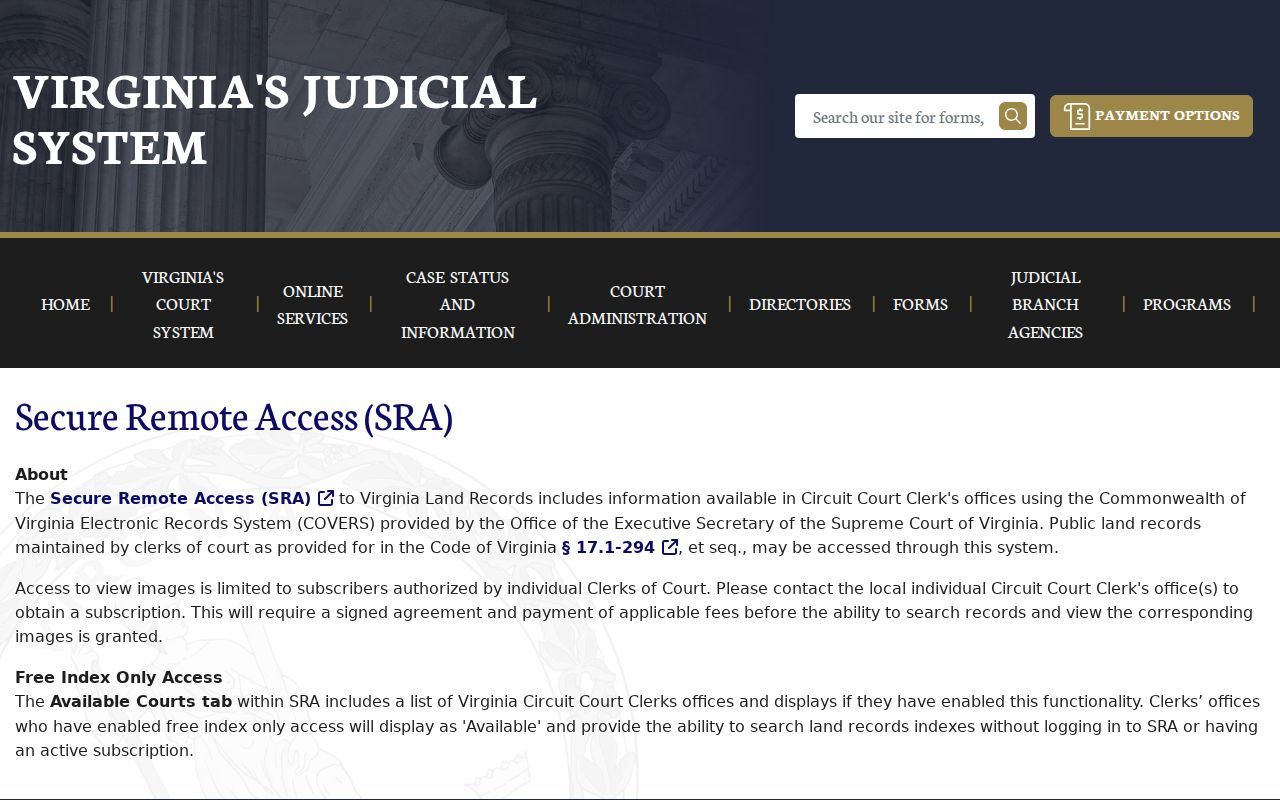
The state page explains why some index hits lack images.
Walking the Nelson County Deed Chain Backward
A chain of title links owner to owner. Each recorded transfer stands in order, and Nelson County records rest on party names, parcel descriptions, and filing references. The map number helps. It never replaces the deed itself. Search backward from the known grantee and confirm the land description at each step.
- Find the latest deed for the parcel and note its grantee, grantor, date, and description.
- Search the grantor as a grantee in an earlier deed, then compare the legal description.
- Record each book/page or instrument reference and look for releases, partitions, or estate transfers.
- Stop and ask the Clerk when the online coverage ends or the parcel description changes.
- Grantor / grantee
- The party conveying an interest and the party receiving it on a deed.
- Chain of title
- The ordered sequence of recorded transfers that links one owner to the next.
- Legal description
- The written boundary or parcel text, which may use acreage, bearings, roads, streams, and adjoining land instead of a street address.
Nelson County Deed Books and Microfilm
Nelson's Clerk public-records room at 84 Courthouse Square is the first local stop for older deed indexes and books, and the county describes its land records there as fully searchable. The Library of Virginia posts a Nelson County microfilm results page as well. Its text is thin, though. Reel-by-reel rows and exact year coverage are not fully listed, so use the catalog to spot a collection and verify the reel and access rules with the repository.
A source may stop showing the chain. Keep the last known instrument number, the names, and the map number together at that point. The Clerk can name the deed book and grantor-grantee index to check. A film catalog is a finding aid. It is not a guarantee.
The Library of Virginia Nelson catalog lists county holdings.
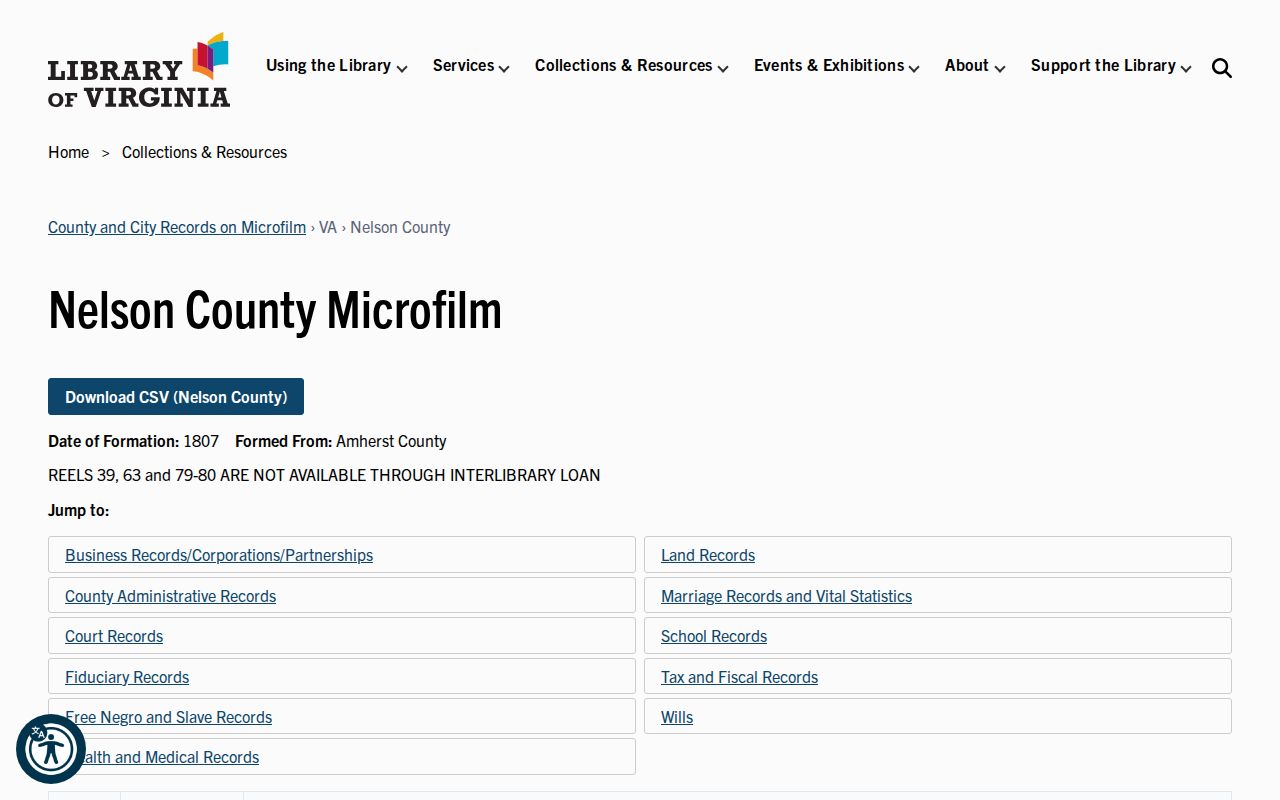
The catalog is the route to reel-level holdings that need a follow-up check.
Nelson County's 1807 Records Boundary
Nelson County formed in 1807. It was carved from Amherst County. A chain for land transferred before that date may reach into Amherst or earlier predecessor records, and no source states a starting year for the present Nelson deed books or confirms a specific deed-book loss. Hurricane Camille brought devastating flooding, landslides, and communication failures in 1969. County history names no destroyed land record. Treat a gap as a research question, and ask the Clerk, the LVA, and local historians about the exact parcel.
The county history page gives the formation year. It also covers Camille.
Historic context can point you toward an old place name. The deed chain itself still needs records.
Nelson County Parent Tracts and Plats
An old deed rarely matches a modern parcel shape. Nelson County deeds from earlier eras describe land by acreage, stream and road calls, and the names of adjoining owners. Metes-and-bounds text does the real work. A current map number is just an administrative key. It is not a story of how the lot came to be.
To untangle the tract, read the older deed's boundaries first. Then follow the seller backward and the buyer forward. Record every book and page or instrument number. Compare each later split or combination against what came before. The County GIS map helps you locate the parcel on the ground. But the recorded description and plat still carry the title detail.
Estate transfers can break a simple seller-to-buyer chain. Nelson County's probate packet directs a personal representative to obtain tax cards from the Commissioner. It also directs them to contact GIS separately for parcel updates. Search the Circuit Court file for the qualification, the will, any court order, or a deed of distribution. Confirm that a transfer instrument was actually recorded. Heirs may not show up as taxable owners until the record reaches the Land Book.
Keep a small chronology for every link. Include the recording date, grantor, grantee, instrument reference, map number, and the boundary language describing the tract. A deed can be executed on one date and recorded much later. So organize the public chain by the Clerk's recording reference. When a parent tract is divided, add the plat or later conveyance that explains the new lot. Never assume the old acreage describes the modern parcel.
Nelson County Family and Community Files
Nelson Memorial Library holds the Historical Society research files. They are arranged by family surname and by topic. The coverage spans county history, cemeteries, churches, communities, homes, post offices, schools, transportation, and wars. A volunteer research committee staffs the collection Wednesday afternoons from 1:00 to 4:00 p.m. The files can link a family name to a place. That helps when a deed uses an old community or road name that no longer appears on maps.
Treat the files as leads, not proof. A property connection still needs a map number, deed, plat, probate order, or other recorded transfer to stand. The county history and genealogy page describes the collection.
The files add color about a community. They cannot establish ownership on their own. The Nelson Memorial Library page lists library information.
Library collections can help identify names and places to check in the deed trail.
How Far Back Nelson County Ownership Records Go
The searchable chain may reach further back than the online interface shows. Ask the Clerk which deed book, index, or microfilm covers the year you need. Nelson County formed in 1807. A pre-county land trail can leave Nelson property records and pass into Amherst sources. No specific deed-book loss is documented. A storm such as Camille is not proof of a gap. The paper record is usually deeper than the screen.
When an online name search stops returning results, take the last instrument number, recording year, parties, and map reference to the Clerk's public-records room. The county describes it as fully searchable. The Library of Virginia's county catalog can flag a microfilm collection for early deeds. Its result page does not list the exact reel span. Ask the repository to confirm which book or reel covers the missing stretch. Then you can judge the chain on evidence rather than guesswork.
Older chain. The online cutoff is unknown. Ask the Clerk where the deed books begin and use LVA microfilm for the historic span it lists. Former-owner research belongs in house history, title review, and property diligence, not in tracking or harassing people.